

The conversation on social media right now is heavy, and for good reason. When we hear the NAACP and the Congressional Black Caucus (CBC) sounding the alarm about a “devastating blow” to the Voting Rights Act, the natural reaction is defensive. We know the history, we know the sacrifice, and we know what happens when this country decides Black political power is “too much.”
But we have to be able to hold two truths at once. We can be protective of our rights while being honest about what those rights have actually bought us lately.
The Reality of the Map vs. The Reality of the Vote
The headlines make it sound like your right to walk into a booth and cast a ballot has been erased. It hasn’t. In Louisiana v. Callais, the Supreme Court didn’t strike down your vote; they struck down a specific map where race was the “dominant factor” in how the lines were drawn.
The CBC is calling it a “Trump Court” attack, and while the legal stakes are high — with estimates that up to 20 CBC members could lose their seats — we have to ask the question that Judge Joe Brown recently raised: What has materially changed for the people living inside those “protected” districts?
Representation Doesn’t Always Equal Results
For sixty years, we’ve fought for majority-minority districts to act as a “shield” for our interests. But in many cases, that shield has turned into a tool for politicians to guarantee safe seats for themselves while the communities inside those lines remain in crisis:
- Baltimore: As recently as 2024, over 275,000 homes still needed lead pipe inspections, and the city’s public school system has required water fountains to be shut off since 2002 due to lead contamination — with only 11 of 170 schools having filtration systems.
- Detroit: In August 2024, children were sent home early because school buildings lacked adequate cooling, even as the district faces some of the deepest federal funding cuts in the country.
- New Orleans: The city’s Black population has declined by more than 120,000 people since Katrina. Black residents were systematically shortchanged by the Road Home rebuilding program, which gave people in wealthier, predominantly white neighborhoods more of what they needed to fully rebuild. The districts were “protected” by the map, but the people weren’t protected from being priced out or left behind.
Breaking the “Loyalty Tax”
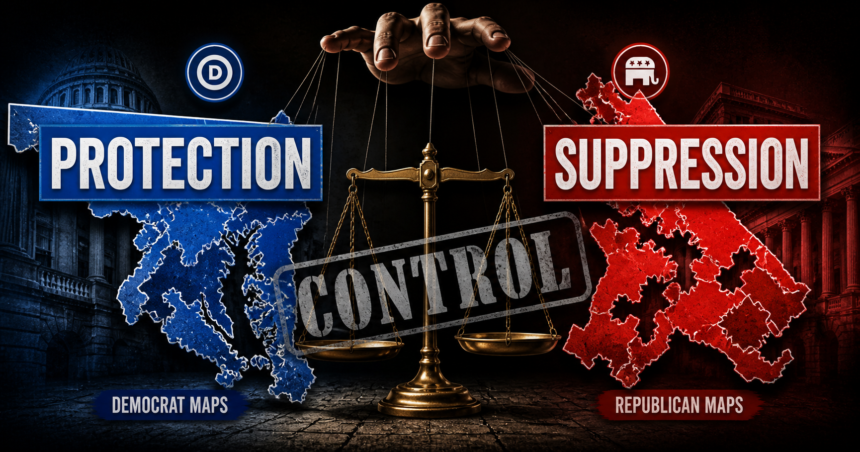
The narrative we’re fed is simple: Democratic maps are “protection” and Republican maps are “suppression.” But both parties have been caught red-handed using gerrymandering to serve their own interests rather than the voters. In Maryland and New York, courts have thrown out maps drawn by Democrats for being “extreme partisan gerrymandering” — drawn with “impermissible partisan purpose” in violation of their own state constitutions.
When we are told that our only choice is to defend a map that hasn’t fixed our water, our schools, or our streets, we are paying a loyalty tax. We are giving our votes in exchange for representation on paper, but we aren’t seeing the results in our daily lives.
Cynicism vs. Citizenship
Democracy doesn’t just cry when a map changes; it cries when a representative goes quiet the moment governing begins.
Your anger is justified, and the history of the VRA is written in blood that must be honored. But honoring that sacrifice means more than just voting for the person who screams about “voter suppression” the loudest every two years. It means demanding that Black representation actually delivers Black results — in policy, in investment, and in outcomes.

Demanding an accounting for your vote isn’t being a cynic — it’s being a citizen.
And Black America has always deserved the best of both.