

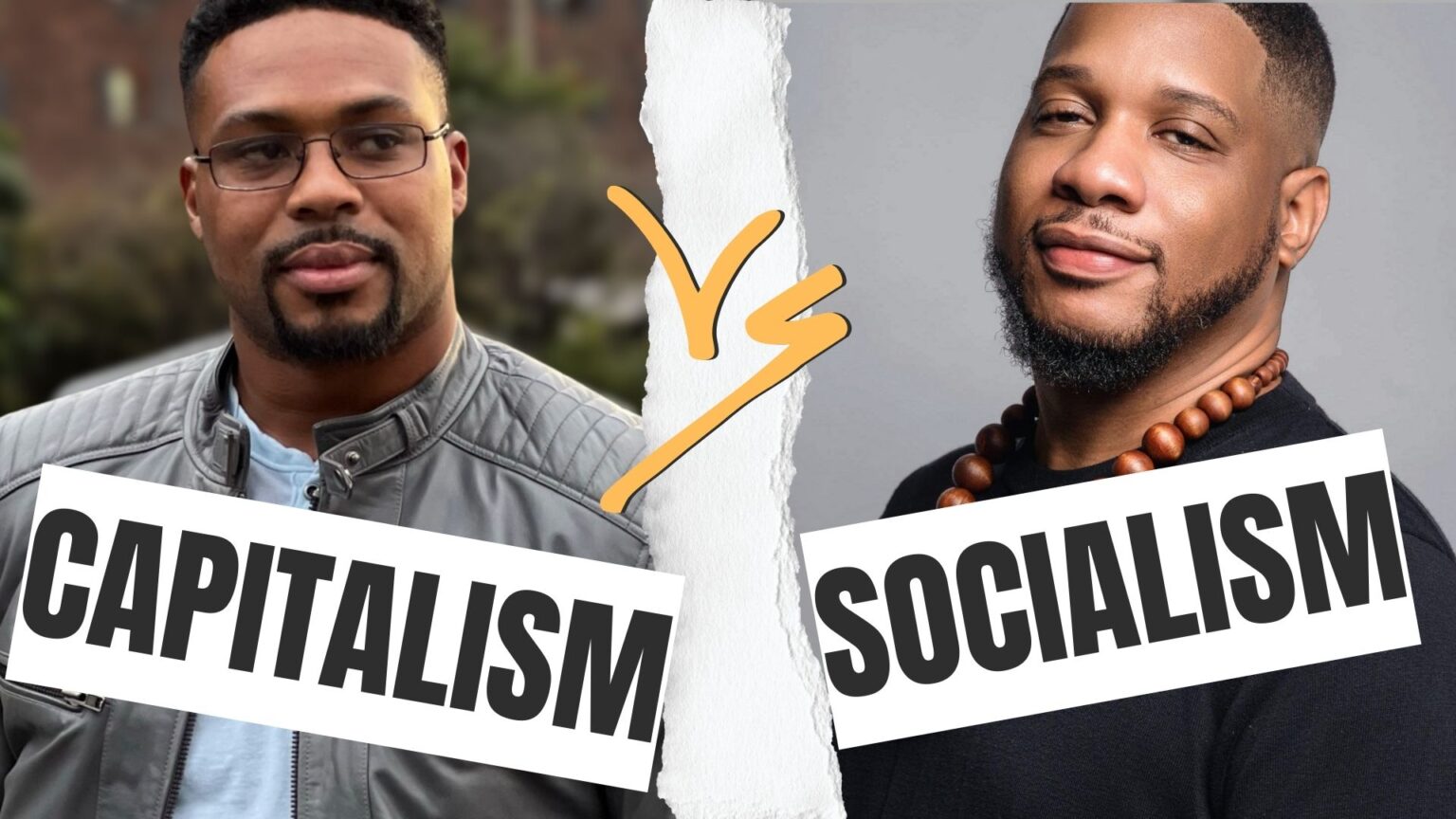
We invited Dayvon Love onto the show to have what we thought would be a straightforward conversation: socialism versus capitalism. Not slogans, not caricatures — an honest exchange of ideas. That was the stated goal, and we meant it.
By the end of the conversation, however, something far more revealing happened. Dayvon made an admission that stopped the debate cold. Not shocking in the sense that we didn’t already understand the worldview behind socialism — but shocking because he said it plainly, out loud, without the usual euphemisms.
- For socialism to work, the American social order would have to cease to exist. (01:28:13)
That sentence matters. Because it confirms what many people still refuse to believe: this ideology is not interested in reforming America. It is not seeking to improve the constitutional system, correct excesses, or strengthen communities within it. It views the country itself as illegitimate — a structure so morally corrupt at its foundation that it must be dismantled before “justice” is even possible.
Once that admission is made, the conversation changes. This is no longer a debate about policy preferences or economic tradeoffs. It becomes a question of survival — of whether a free society has the moral clarity to recognize an ideology that cannot coexist with it.
Socialism Is Not Neutral About America
Throughout the conversation, the premise remained consistent: America is a colonial project, morally irredeemable, and incapable of producing justice. That framing isn’t accidental. Socialism requires a villain large enough to justify total reconstruction, and America fills that role perfectly.
This is why every failure of socialism is blamed on external forces. Sanctions. Markets. Western influence. Capitalism. The system itself is never allowed to be the problem. And when asked where socialism works today, the answer always collapses into abstractions, ancient civilizations, or future hypotheticals — anywhere except the present.
The implication is clear. Socialism doesn’t intend to compete with America. It intends to outlast or destroy it.
Grievance Without Limits Becomes Power
History matters. It should be taught honestly and remembered clearly. But socialism doesn’t use history as instruction — it uses it as leverage. Grievance becomes permanent. Moral debt never expires. Forgiveness is treated as betrayal, and progress is dismissed as illegitimate.
This is how agency disappears. If every outcome is predetermined by historical oppression, responsibility becomes optional. And once responsibility is removed, power has to go somewhere else. It always ends up centralized — in the state, the party, the institution that claims to speak for the collective.
That’s not liberation. That’s dependency with a moral justification.
Centralized Control Is the End Goal
Despite softer language about community and abundance, the structure underneath never changes. Private property is treated as suspect. Individual choice is framed as dangerous. Markets are described as immoral. And the state is positioned as the rightful distributor of resources, opportunity, and outcomes.
Every socialist system eventually arrives at the same place: centralized authority deciding whose needs matter, whose speech is acceptable, and whose freedom must be restricted for the “greater good.” When the individual is subordinate to the system, freedom becomes conditional — and temporary.
This isn’t a flaw in execution. It’s the design.
Why America Must Fall
The most revealing moment of the conversation wasn’t about Venezuela, history, or economics. It was the acknowledgment that socialism cannot flourish while America exists as a counterexample. A nation built on individual rights, private property, and reformability is an existential threat to any ideology that depends on total control.
That’s why the conversation ultimately went where it did. For socialism to work, America must end.
That admission matters more than any statistic. Once it’s spoken aloud, the mask comes off.
Why We Bring Back Shame
Shame isn’t cruelty. Shame is moral clarity. It’s the internal alarm that warns a society when it’s entertaining ideas that dissolve responsibility, hollow out families, and replace human dignity with bureaucratic control.
Socialism doesn’t fail accidentally. It fails predictably. And when its advocates finally stop avoiding the hard questions, they reveal the truth themselves.
This was never about fixing America.
It was about ending it.
Now, at least, it’s no longer hidden.