

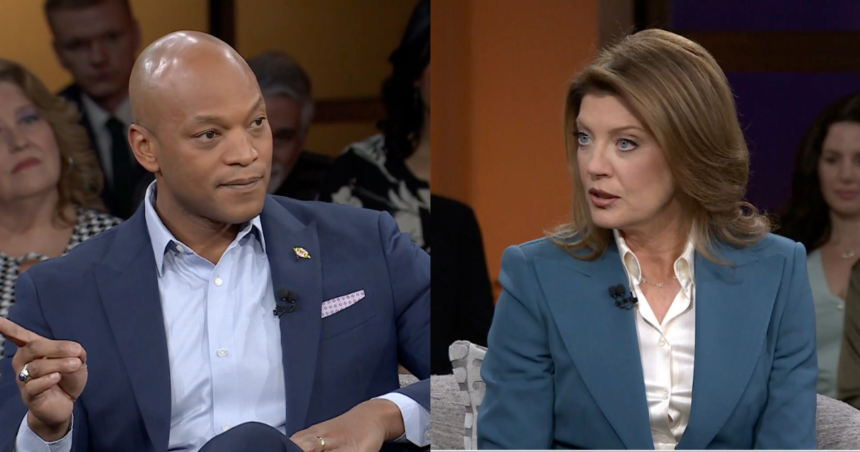
On February 12, 2026, CBS launched its national series, Things That Matter, from The Packing House in Cambridge, Maryland. The guest was Governor Wes Moore. The timing was symbolic. Black History Month. The location was deliberate. Cambridge, a city that served as a hub on the Underground Railroad, and not far from the birthplace of Harriett Tubman. The framing was unmistakable. America’s only Black governor on a national stage.
On paper, it was civic engagement.
In practice, it felt like a glorified podcast with a studio audience.
There were no follow up questions. No sustained pushback. No moment where the Governor had to sit in discomfort and answer something unscripted. Attendees submitted questions in advance. We do not know who selected which questions made it to air. What we do know is that nothing remotely difficult disrupted the flow.

This was not a town hall.
It was theater.
The Illusion of Bipartisanship: Topic of Redistricting
CBS assembled a room that looked bipartisan. Prominent Republicans. Members of Moms for Liberty. Victims of Violent Crimes, Maryland Young Republicans. Central Committee members. Democrats and Independents.
On camera, it looked unified.
But optics are not substance.

One of the clearest examples of that disconnect is redistricting — the process by which congressional district lines are drawn and redrawn, often in ways that determine which voters are grouped together and, ultimately, which party holds power.
According to Marylands most recent voter registration data (Jan 2026):
- About 2.2 million Democrats
- About 1.02 million Republicans
- About 990,000 unaffiliated voters
Republicans make up roughly 23 percent of registered voters. Yet Maryland’s congressional delegation stands at 7 Democrats and 1 Republican.

Under proposed redistricting maps, even that lone Republican seat may be carved apart. When pressed on this issue, the Governor referred to the process as democracy. Nora O’Donnell briefly noted the imbalance. But there was no sustained challenge. No follow up asking how 23 percent of the electorate consistently translating into 12.5 percent representation, and potentially zero, constitutes fair representation.
Yes, Democrats outnumber Republicans in registration. But nearly one million Marylanders are unaffiliated. Electoral coalitions are not static. Representation should not be engineered to eliminate competition.
That debate was not meaningfully had.
Immigration, ICE, and What Was Not Said
On immigration policy, the Governor repeated a familiar phrase. We are going to follow the law.
At the same time, Maryland is actively changing the law.
HB0444 and SB0245 would restrict how local law enforcement cooperates with ICE. During the town hall, the Governor framed cooperation with ICE as deputizing local law enforcement to do federal immigration work. He stated that Maryland law enforcement will do their jobs and that the state will follow the law regarding ICE cooperation.
But that framing blurs a critical distinction.
This is not about local officers conducting immigration raids. It is about cooperation in cases where individuals are already detained for legitimate criminal charges and ICE seeks a custody transfer before release.
That distinction was never clarified.
There was no definition of public safety.
No acknowledgment of violent offenders being released back into communities if coordination is restricted.
No mention of Dacara Thompson. No mention of Rachel Morin. No reference to victims in Maryland whose cases have intersected with immigration enforcement failures.
Instead, the issue was framed as protecting immigrant communities, with references to the Governor being raised by an immigrant single mother.
Emotion was offered. Precision was not.
Energy Without Production
The exchange on energy may have been the most revealing.
Maryland now ranks among the most expensive states in the country for electricity. Fossil fuel power plants are closing faster than replacement generation capacity is coming online. When asked about rising costs, the Governor responded that we have not done enough and pointed to rebate programs for struggling Marylanders.
But rebates do not generate power.
What was missing from the discussion was the basic distinction between:
- Energy production
- Energy delivery
- Energy storage
Grid strain was mentioned. Permitting delays were mentioned. Projects needing to be greenlit were mentioned. But there was no serious conversation about baseload generation, dispatchable capacity, plant closures, or the mathematical reality of supply versus demand.
Maryland is part of the PJM regional grid. We are willing to purchase power generated elsewhere while accelerating in state plant closures under clean energy initiatives. Offshore wind funding cuts were criticized, but there was no explanation of whether those projects could realistically replace lost capacity in the near term.
Delivery does not matter if you are not producing enough electricity to deliver.
Marylanders feel that gap every time they open their utility bills.
A Room Full of Marylanders, But Whose Questions Made It?
Everyone in attendance was asked to submit a question as part of the invitation. People drove from across the state with the expectation that their question might be asked — which is likely why many made the trip.
- St Mary’s County
- Carroll County
- Montgomery County
- Harford County
- Baltimore County
And many others.
Some drove two hours or more. It was a cross-section of Marylanders. And yet the most difficult, forward looking, and economically strategic questions never surfaced.
Here are a few examples of questions that were submitted but unanswered:
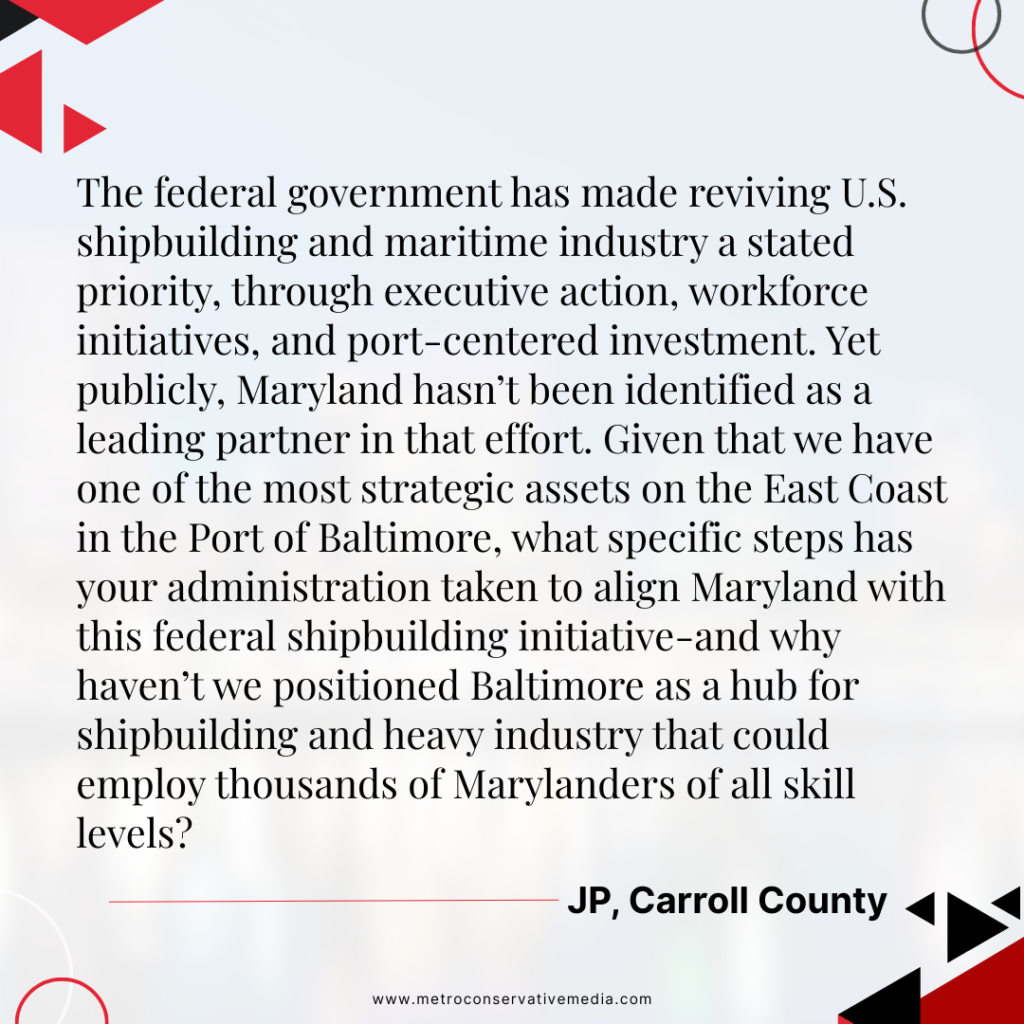
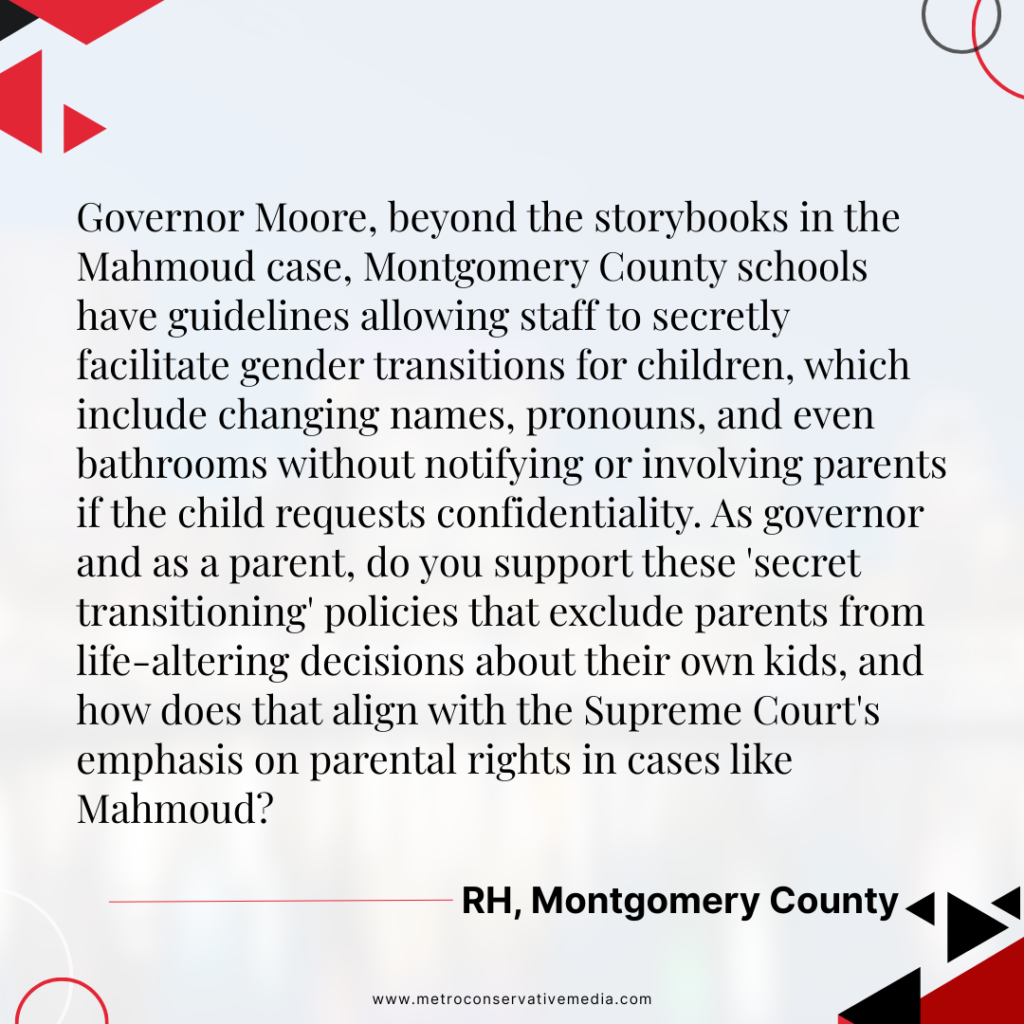
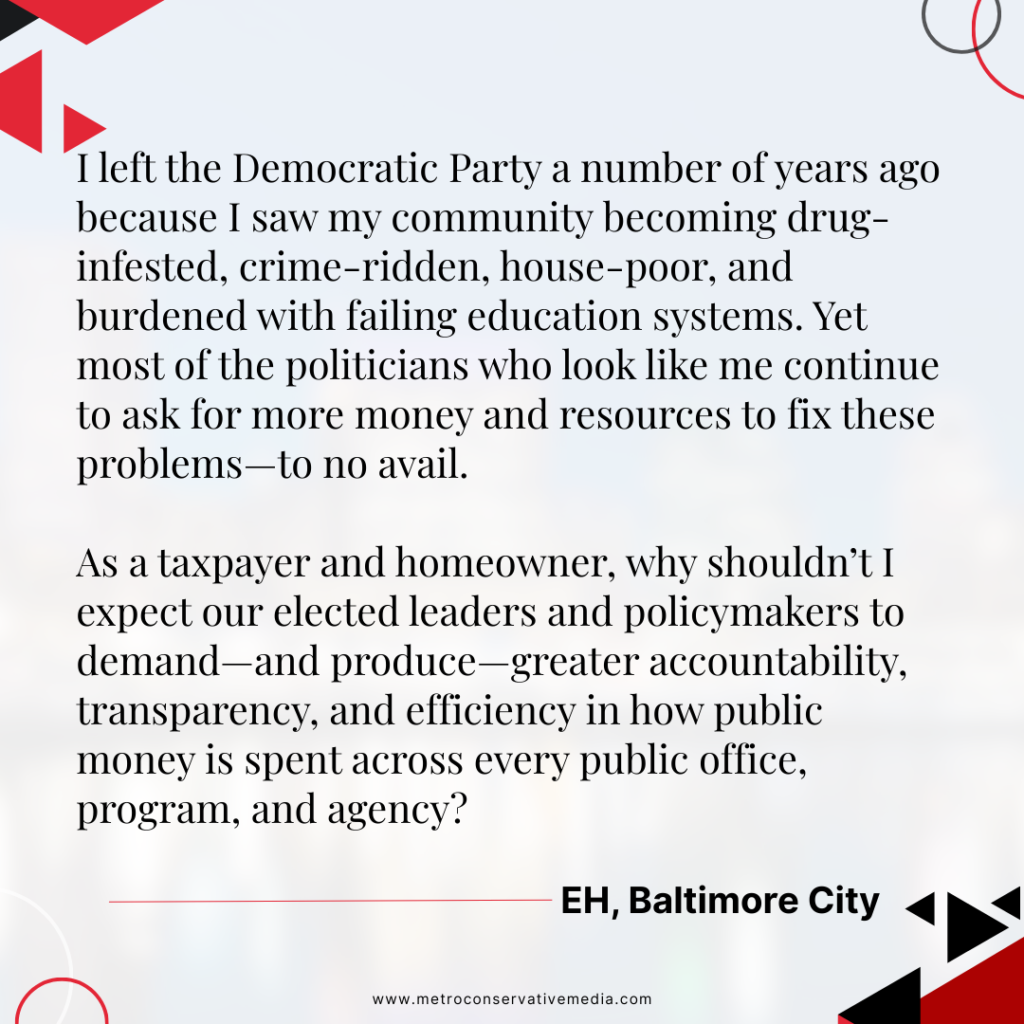
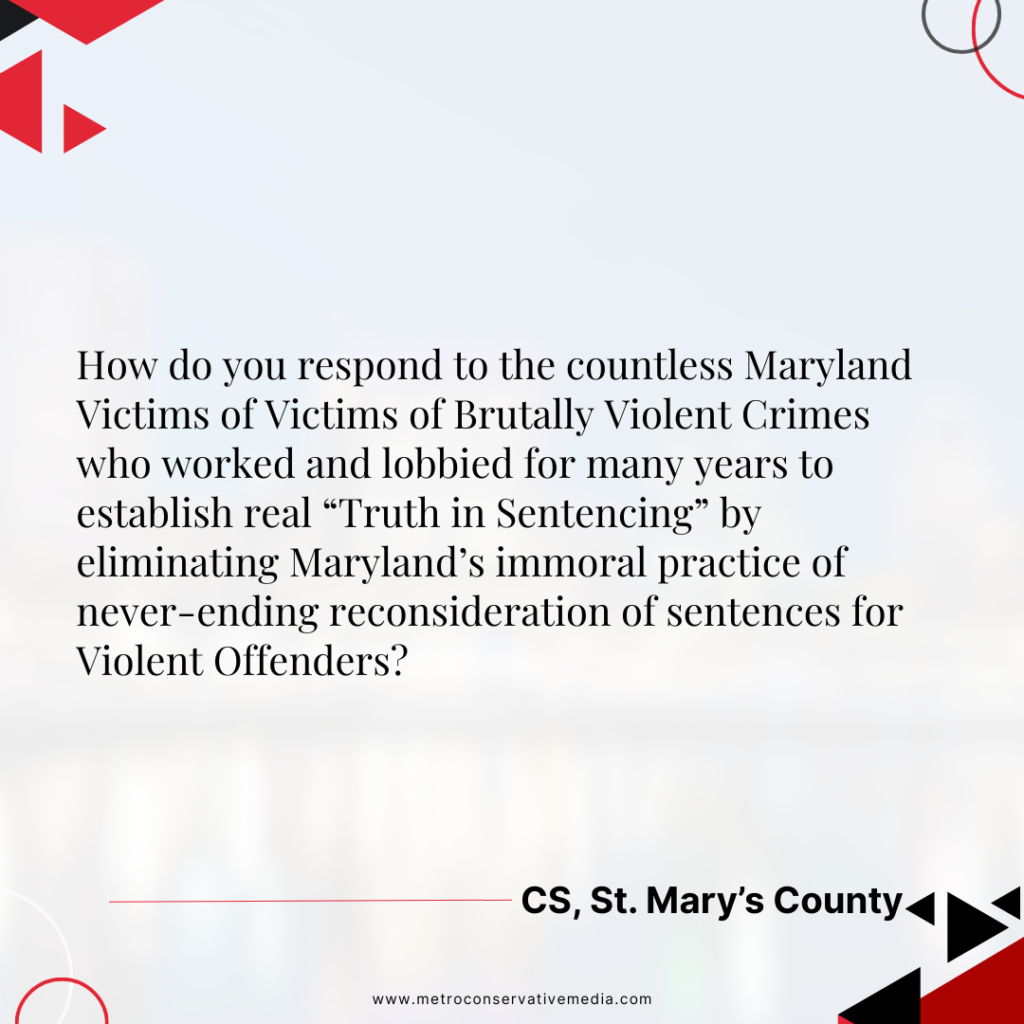
These are Maryland questions.
They never made the stage.
If you attended this town hall and submitted a question that was not asked, I want to hear from you. Share the question you submitted. Maryland deserves to know what conversations were left on the cutting room floor.
When Governance Becomes Performance
Governor Moore is a skilled communicator. He presents as bipartisan. He speaks in values language. He is disciplined and polished.
But communication is not governance.
When redistricting reduces competition while being called democracy, when immigration debates avoid defining public safety, when energy discussions skip production math, and when hard questions never see daylight, that is not civic dialogue.
It is stagecraft.
If this is what Things That Matter looks like, then perhaps the real question Marylanders should ask is this:
Who decides what actually matters?