
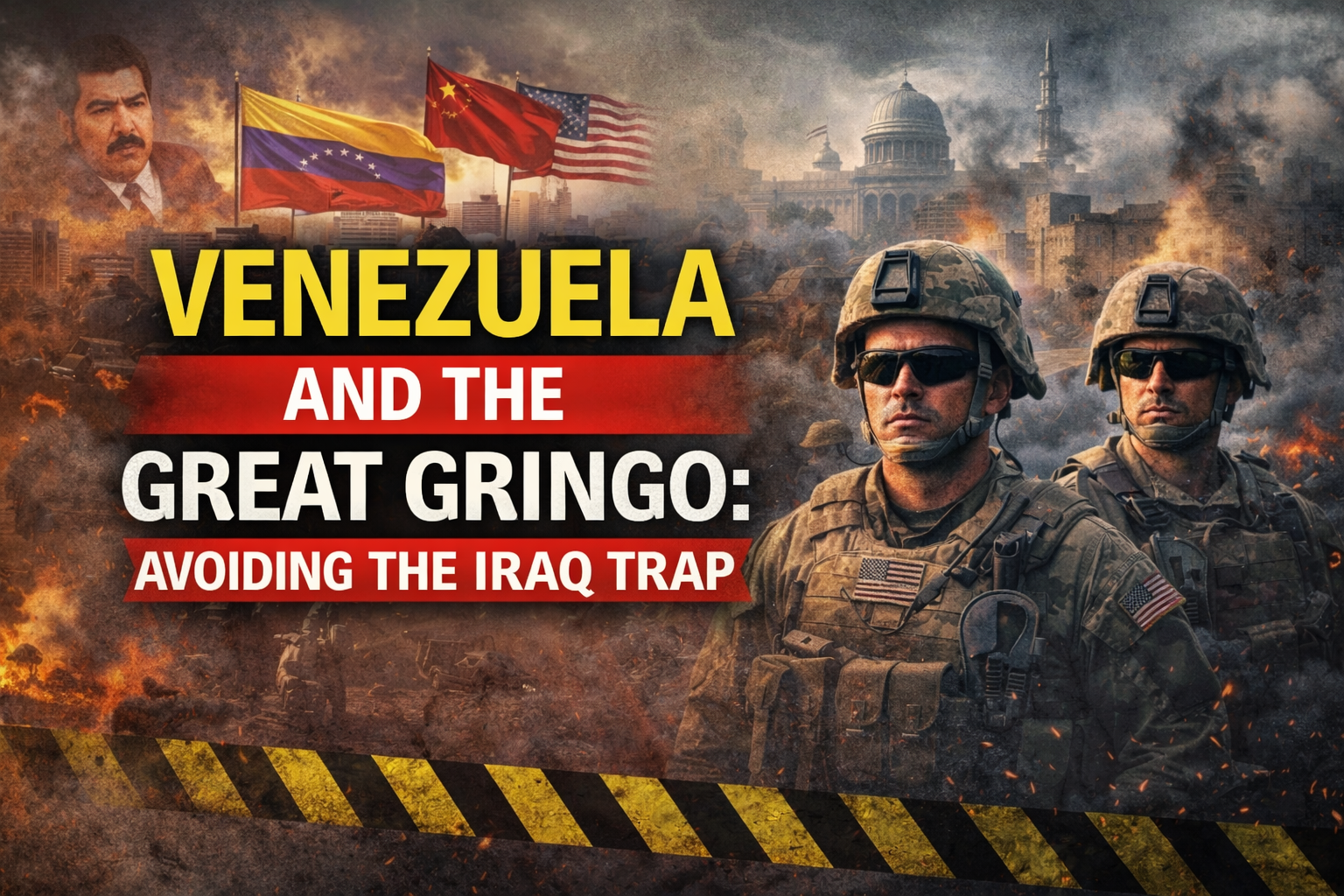
While much of the world celebrates the capture of Nicolás Maduro, the more conservative corners of the Republican Party harbor legitimate concerns. We champion liberty, but we recognize that Venezuelan freedom must not come at an unacceptably high cost to Americans. Without a disciplined strategy, Venezuela could become this generation’s Iraq: a “nation-building” project rife with billions in wasted taxpayer dollars and the loss of American lives.
There is a profound difference between stabilization and sovereignty. America should assist in stabilizing the region, but rebuilding Venezuela is the sole responsibility of its people. America must learn from the mistakes that occurred during our last foray into nation-building in Iraq. We must use the abject failure of Iraq policy as a guiding light to avoid bankrupting another generation in the name of failed states.
The Shadow of “The Great Gringo”
American intervention in Latin America is historically fraught. While we intervene to defend our hemisphere, those facing our unmatched military force often perceive it as imperialism. Maduro’s remnants—many of whom remain in place and remarkably loyal—will undoubtedly frame any U.S. involvement as aggression by the “Great Gringo” in order to fuel a nationalist insurgency.
Latin American nations prioritize non-intervention. A heavy-handed approach could further destabilize a region already plagued by institutional decay and purposeful mismanagement. It would take decades to dismantle the criminal “deep state” entrenched in Caracas. External actors are rarely equipped to successfully navigate a criminal deep state that forms the very foundation of a government. Regime change at a systemic level would not satisfy the Venezuelan people’s demand for self-governance, duly elected by their own citizens. Self-determination is key. True democracy cannot be installed; it must be chosen. For any transition to hold domestic legitimacy, it must be led by Venezuelans—not labeled a U.S.-imposed government.

The UN and the Transition
The United Nations has voiced predictable concerns over any removal of Maduro by America’s elite warfighters. Some partner nations—none of whom are current on their financial commitments to the organization—have expressed grave concern about the United States deposing “elected” officials without a Security Council mandate. However, Secretary of State Marco Rubio and the Trump Administration have rightly ignored these demands.
The United States remains committed to defending our homeland and our hemisphere. No amount of bluster or strongly worded statements will change this Administration’s commitment to American values. For the U.S., intervention in Venezuela—as in Iraq—has less to do with oil or other riches than with the removal of tyrants and dictators and the pursuit of a safer world.
While Venezuela’s oil wealth can fund recovery, being “oil-rich” is no guarantee of stability. The risk of creating an economy managed solely around extraction rather than a broad-based approach to reconstruction will likely lead to further inequality and social unrest. Creating a system in which the wealthy continue to prosper while the poor have no path to upward mobility will topple a fledgling government and usher in renewed civil unrest.
Continued political uncertainty and the threat of infrastructure sabotage by disgruntled factions—potentially backed by actors such as Russia and China—create a high-risk environment for the very investors needed for recovery. Without stabilization efforts that include significant financial and security resources, dependency on the U.S. taxpayer becomes nearly inevitable. Much like the debacle in Iraq, we could expect long-term, costly entanglement involving infrastructure, economic restructuring, housing, roads, schools, and hospitals to prop up a fragile government—all at the expense of American taxpayers.
A Path Forward: Repatriation and Leadership
Venezuela needs its leaders. While Nobel Peace Prize winner María Corina Machado has a mandate, dismantling the criminal underworld is a monumental task. Venezuelans who escaped Maduro’s tyranny have a duty to help rebuild their nation. Now is the time to heal from the horrors of the past and work diligently to build a country all Venezuelans can be proud of.

To assist, the United States must prioritize the return of Venezuelan nationals to their homeland. Ending Temporary Protected Status (TPS) and encouraging the return of the diaspora would provide the human capital necessary to rebuild Venezuela’s economy and culture, while relieving financial burdens on the U.S.
Lessons from History
U.S. intervention in Iraq began with good intentions. The initial military action—Operation Iraqi Freedom in 2003—was swift and tactically successful. The shock and awe of American military power were on full display. However, subsequent efforts to build a democratic state collapsed due to catastrophic policy decisions and a fundamental lack of cultural understanding. These failures cost American taxpayers billions and, more importantly, thousands of American lives.
The errors made in Iraq haunted my generation and created a conservative class with a healthy aversion to war-mongering that borders on isolationism. As a proud member of that class, two specific decisions changed my worldview—and offer clear lessons for how the Trump Administration can avoid demoralizing and bankrupting another generation.

Coalition Provisional Authority Order #1 (De-Ba’athification)
This order banned all members of Saddam Hussein’s Ba’ath Party from public-sector employment. In theory, removing ruling party members sounded like a “clean sweep.” In practice, it became a devastating brain drain. In a totalitarian system, party membership was required for basic employment. By purging civil servants en masse, the U.S. effectively fired physicians, teachers, engineers, and mid-level administrators, causing Iraq’s infrastructure to collapse almost overnight. Without experienced professionals, even basic tasks like restoring electricity and water became nearly impossible, fueling public backlash. Free and fair elections are meaningless if basic services cannot function.
Coalition Provisional Authority Order #2 (Disbanding the Military)
Shortly thereafter, the U.S. disbanded the Iraqi Army, sending roughly 400,000 trained and armed soldiers home without pay or pensions. This decision created a ready-made insurgency. Without a domestic security force, Iraq descended into lawlessness marked by looting and chaos. The overstretched U.S. military was in no position to police a population suddenly deprived of water, electricity, and security—all in the name of freedom and democracy.
Ethnosectarian Fighting
The assumption that removing Saddam Hussein would naturally unify Iraq into a functioning democracy proved disastrously wrong. Intelligence agencies failed to adequately consider ethnosectarian divisions among Sunnis, Shias, and Kurds. Decades of suppressed grievances erupted into brutal civil war—one the U.S. was ill-equipped to mediate.
Many personnel sent to rebuild Iraq were political appointees with little experience in governance, language, or Middle Eastern culture and history. While Iraqis desperately needed security, water, sewage, and electricity, the U.S. focused on complex institutional reforms that ignored basic needs. Massive amounts of taxpayer money were funneled into a failed state, which various factions treated as a cash cow—entrenching corruption that persists to this day.
The Marshall Plan
To avoid repeating Iraq’s mistakes, America should adopt best practices from the Marshall Plan, which successfully rebuilt postwar Germany. A firm exit date must be set—and honored. Americans need assurance that we will not fund endless peacekeeping or nation-building operations.
Venezuela’s economy must be diversified, allowing growth across all socioeconomic strata. Investment in oil and rare minerals should be balanced with the development of other economic drivers. Regional cooperation must be insisted upon, as building strength across the hemisphere—not just in Venezuela—is essential.
Most importantly, the Venezuelan people must be given a voice. Elections should be held regularly, free from intimidation or corruption. Americans know that government of the people, by the people, works best. Securing the hemisphere does not require boots on the ground or the bankruptcy of our future.
May God bless the Venezuelan people. Now is the time to return home and make Venezuela great again.